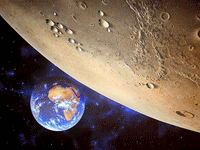
ET call home
Page 1 of 2 • 1, 2 

 ET call home
eddie Sat Apr 30, 2011 4:46 pm
Is there anybody out there or are we really alone in the universe?
Nicholas Lezard guardian.co.uk, Thursday 28 April 2011 08.00 BST
The title is a reference to Enrico Fermi's famous question: "Where is everybody?" In its context, what he meant was: "if there are alien civilisations, why haven't we seen any evidence of them yet?" This is a book about the search for extraterrestrial intelligence written by someone who knows whereof he speaks, for he is chair of Seti's post-detection science and technology taskgroup. In other words, if everything goes according to protocol (which it probably won't, but never mind), he gets to say "hello" first to any aliens who say "hello" to us. This might seem an awesome responsibility, but Professor Davies is used to dealing with concepts that are somewhat out of the ordinary. The last book by Davies that I reviewed, The Goldilocks Enigma, was full of mind-blowing stuff, intelligibly and plausibly presented. And here is more of the same, or similar.

The Eerie Silence: Searching for Ourselves in the Universe by Paul Davies
You could question the wisdom of trying to see if anyone else is out there. (There are people who want to stop others making deliberate attempts to contact aliens on the grounds that they may find this planet rather covetable and kick us off it. To which one can only say that they have not seen Harlesden on a wet Sunday afternoon.) You may also question the very discipline of exobiology, or imagining what alien biology is like. After all, it isn't as if anyone has anything to go on.
But that has not stopped Davies writing another superb science book, which both sticks to its remit and touches on larger issues in a manner that helps them slip down easily without making us feel that we have been condescended to. This is an intelligent, enthusiastic man who communicates his enthusiasm, and the scientific concepts that are his subject, in clear prose that you do not have to be a scientist to appreciate.
If you do not accept the sentiment behind the book's epigraph – Arthur C Clarke's remark that "sometimes I think we're alone in the universe, and sometimes I think we're not. In either case the idea is quite staggering" – then perhaps this is not for you. Which would be a pity, for Davies brings many elements into play. "Contemplating a seriously alien intelligence . . . means we must jettison as much mental baggage as possible," Davies says in his introductory chapter. He then goes on to restock our minds with such concepts as the possibility of there being different forms of life from the carbon-based kind we are so familiar with (the next best bet is not, pace Star Trek, silicon-, but arsenic-based), and which may yet be discovered on earth; the odds against life, let alone intelligent life, arising anywhere (astronomical, basically); the habitability windows of potential civilisations; the possibility of nanoprobes encoded in viruses or in our very own DNA; not to mention quantum computers, Dyson spheres (a shell surrounding a sun at planetary orbital distance), and the idea of post-biological intelligences.
On the question of computers versus the human brain, he will make you feel fairly good: a computer that can perform as many operations per second – or "flops" – as the brain is possible, but "the big difference is that the computer would consume several megawatts to do it, whereas the brain gets by on three meals a day". And who could not love the rubric describing Fig 11? "Whimsical depiction of energy extraction from a black hole."
And there are some scientists one cannot help but love: the ones who are both romantic and practical, who got fired up as children watching, say, 2001: A Space Odyssey and have devoted their lives to seeing whether there is anything in it. Davies is such a one. His conclusions are open-minded, capable of withstanding robust inquiry, albeit a little depressing. Apparently alien intelligence is overwhelmingly likely to be post-biological, a "matrioshka brain" which amuses itself by solving ever more abstruse mathematical theorems. "I confess this seems to me a rather narrow vision of thrill-seeking," Davies writes ruefully, "but it may be that an Extraterrestrial Quantum Computer would rapidly exhaust all other possible experiences." Even, it would seem, the pleasure of reading this very entertaining and mind-expanding book.
guardian.co.uk © Guardian News and Media Limited 2011

eddie- The Gap Minder
- Posts : 7840
Join date : 2011-04-11
Age : 68
Location : Desert Island

Re: ET call home
eddie Sun May 01, 2011 3:06 am
"There are people who want to stop others making deliberate attempts to contact aliens on the grounds that they may find this planet rather covetable and kick us off it. To which one can only say that they have not seen Harlesden on a wet Sunday afternoon...."
I must be one of the very few carbon-based bipedal life forms who HAS seen Harlesden (an unprepossessing North London suburb on the Bakerloo line) on a wet Sunday afternoon and didn't entirely lose the will to live.
It was a close shave, though.


Craven Park Road, Harlesden when it's not raining and the shops are open.
eddie- The Gap Minder
- Posts : 7840
Join date : 2011-04-11
Age : 68
Location : Desert Island
Re: ET call home
eddie Mon Jun 20, 2011 8:27 pm
Alien Autopsy- UFO crash- Roswell New Mexico (Original footage)
eddie- The Gap Minder
- Posts : 7840
Join date : 2011-04-11
Age : 68
Location : Desert Island
Re: ET call home
eddie Mon Jun 20, 2011 8:30 pm

Photograph of alleged UFO, New Jersey, July 31, 1952.
eddie- The Gap Minder
- Posts : 7840
Join date : 2011-04-11
Age : 68
Location : Desert Island
Re: ET call home
eddie Mon Jun 20, 2011 8:38 pm

This shows the report Kenneth Arnold filed in 1947 about his UFO sighting.

Wiki:
The post World War II UFO phase in the United States began with a famous sighting by American businessman Kenneth Arnold on June 24, 1947 while flying his private plane near Mount Rainier, Washington. He reported seeing nine brilliantly bright objects flying across the face of Rainier.
Although there were other 1947 U.S. sightings of similar objects that preceded this, it was Arnold's sighting that first received significant media attention and captured the public's imagination. Arnold described what he saw as being "flat like a pie pan", "shaped like saucers and were so thin I could barely see them… ", "half-moon shaped, oval in front and convex in the rear. … they looked like a big flat disk" (see Arnold's drawing at right), and flew "like a saucer would if you skipped it across the water". (One of the objects, however, he would describe later as crescent-shaped, as shown in illustration at left.) Arnold’s descriptions were widely reported and within a few days gave rise to the terms flying saucer and flying disk. Arnold’s sighting was followed in the next few weeks by hundreds of other reported sightings, mostly in the U.S., but in other countries as well. After reports of the Arnold sighting hit the media, other cases began to be reported in increasing numbers. In one instance a United Airlines crew sighting of nine more disc-like objects over Idaho on the evening of July 4. At the time, this sighting was even more widely reported than Arnold’s and lent considerable credence to Arnold’s report.
American UFO researcher Ted Bloecher, in his comprehensive review of newspaper reports (including cases that preceded Arnold's), found a sudden surge upwards in sightings on July 4, peaking on July 6–8. Bloecher noted that for the next few days most American newspapers were filled with front-page stories of the new "flying saucers" or "flying discs". Speculation as to what the flying saucers were was rampant in the newspapers. Theories ranged from hallucinations, mass hysteria, optical illusions, hoaxes, reflections off airplanes, unusual atmospheric conditions, and weather balloons to byproducts of atomic testing or U.S./Russian secret weapons, to even more esoteric interdimensional or interplanetary visitors. Reports began to rapidly tail off after July 8, when officials began issuing press statements on the Roswell UFO incident, in which they explained debris found on the ground by a rancher as being that of a weather balloon.
Over several years in the 1960s, Bloecher (aided by physicist James E. McDonald) discovered 853 flying disc sightings that year from 140 newspapers from Canada, Washington D.C, and every U.S. state except Montana.
eddie- The Gap Minder
- Posts : 7840
Join date : 2011-04-11
Age : 68
Location : Desert Island
Re: ET call home
eddie Mon Jun 20, 2011 8:48 pm

Roswell Daily Record, July 8, 1947, announcing the "capture" of a "flying saucer."

The Sacramento Bee article detailing the RAAF statements.
Wiki:
The Roswell UFO Incident was the recovery of an object that crashed in the general vicinity of Roswell, New Mexico, in June or July 1947, allegedly an extra-terrestrial spacecraft and its alien occupants. Since the late 1970s the incident has been the subject of intense controversy and of conspiracy theories as to the true nature of the object that crashed. The United States military maintains that what was actually recovered was debris from an experimental high-altitude surveillance balloon belonging to a classified program named "Mogul"; however, many UFO proponents maintain that in fact an alien craft and its occupants were captured, and that the military then engaged in a cover up. The incident has turned into a widely known pop culture phenomenon, making the name Roswell synonymous with UFOs. It ranks as the most publicized and controversial of alleged UFO incidents.
On July 8, 1947, the Roswell Army Air Field (RAAF) public information officer Walter Haut in Roswell, New Mexico, issued a press release stating that personnel from the field's 509th Bomb Group had recovered a crashed "flying disk" from a ranch near Roswell, sparking intense media interest. The following day, the press reported that Commanding General of the Eighth Air Force stated that, in fact, a radar-tracking balloon had been recovered by the RAAF personnel, not a "flying disc." A subsequent press conference was called, featuring debris said to be from the crashed object, which seemed to confirm the weather balloon description.
The incident was quickly forgotten and almost completely ignored, even by UFO researchers, for more than 30 years. Then, in 1978, physicist and ufologist Stanton T. Friedman interviewed Major Jesse Marcel who was involved with the original recovery of the debris in 1947. Marcel expressed his belief that the military had covered up the recovery of an alien spacecraft. His story spread through UFO circles, being featured in some UFO documentaries at the time. In February 1980, The National Enquirer ran its own interview with Marcel, garnering national and worldwide attention for the Roswell incident.
Additional witnesses added significant new details, including claims of a huge military operation dedicated to recovering alien craft and aliens themselves, at as many as 11 crash sites, and alleged witness intimidation. In 1989, former mortician Glenn Dennis put forth a detailed personal account, wherein he claimed that alien autopsies were carried out at the Roswell base.
In response to these reports, and after congressional inquiries, the General Accounting Office launched an inquiry and directed the Office of the Secretary of the Air Force to conduct an internal investigation. The result was summarized in two reports. The first, released in 1995, concluded that the reported recovered material in 1947 was likely debris from a secret government program called Project Mogul, which involved high altitude balloons meant to detect sound waves generated by Soviet atomic bomb tests and ballistic missiles. The second report, released in 1997, concluded that reports of recovered alien bodies were likely a combination of innocently transformed memories of military accidents involving injured or killed personnel, innocently transformed memories of the recovery of anthropomorphic dummies in military programs like Project High Dive conducted in the 1950s, and hoaxes perpetrated by various witnesses and UFO proponents. The psychological effects of time compression and confusion about when events occurred explained the discrepancy with the years in question. These reports were dismissed by UFO proponents as being either disinformation or simply implausible. However, numerous high-profile UFO researchers discount the probability that the incident had anything to do with aliens.
eddie- The Gap Minder
- Posts : 7840
Join date : 2011-04-11
Age : 68
Location : Desert Island

eddie- The Gap Minder
- Posts : 7840
Join date : 2011-04-11
Age : 68
Location : Desert Island
Re: ET call home
eddie Thu Nov 17, 2011 6:49 pm
By Thomas Moore, science correspondent
Sky News
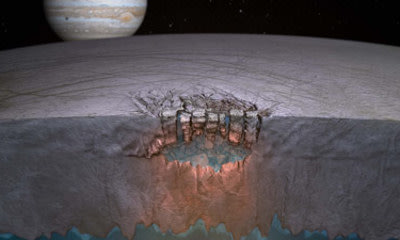
Scientists say their hunt for extra-terrestrial life has been given a boost by new evidence of a massive hidden sea on Jupiter's moon Europa.
The sea - which is as big as the North American Great Lakes - is trapped below several kilometres of ice.
Researchers at the University of Texas made the discovery while studying images taken by the Galileo space craft. They found two rough areas on an otherwise smooth icy crust.
They believe the "crinkles" are caused by floating ice shelves that are collapsing into the water.
Similar features are found on Earth's Antarctic when seawater penetrates and weakens ice shelves.
Lead scientist Dr Britney Schmidt said the breach in the icy shell could drag nutrients and energy down into the water far below.
She said: "One opinion in the scientific community has been: 'If the ice shell is thick, that's bad for biology - the surface isn't communicating with the underlying ocean.'
"Now we see evidence that even though the ice shell is thick, it can mix vigorously. That would make Europa and its ocean more habitable."
American space agency Nasa is currently considering whether to send a spacecraft to Europa that is equipped with a ground-penetrating radar.
The mission could confirm whether there are sub-glacial lakes on the moon.
Robert Pappalardo of Nasa's Planetary Science Section said: "I read the paper and immediately thought, yes, that's it. That makes sense."
The research is published in the journal Nature.
eddie- The Gap Minder
- Posts : 7840
Join date : 2011-04-11
Age : 68
Location : Desert Island
Re: ET call home
eddie Tue Dec 06, 2011 6:01 pm
Nasa discovers planet which is about 2.4 times the size of our own and lies in the 'Goldilocks zone' of its solar system
Ben Quinn
guardian.co.uk, Monday 5 December 2011 21.18 GMT

An artist's impression of the exoplanet Kepler 22-b which Nasa say is the most Earth-like yet discovered. Photograph: AFP/Getty Images
A new planet outside of Earth's solar system has been identified with many similarities to our own – making it the latest best potential target for life.
Kepler 22-b, which is about 2.4 times the size of Earth and lies in the so-called "Goldilocks zone", has a relatively comfortable surface temperature of about 22C (72F) and orbits a star not unlike Earth's sun.
But while astronomers believe that it "probably" also possesses water and land, earthlings secretly harbouring hopes that such a planet could potentially host new colonies from our own increasingly overpopulated home may be in for a disappointment.
About 600 light-years from Earth, Kepler 22-b is a considerable trek away while experts are not yet sure if it is made mostly of rock, gas or liquid
The discovery was made by Nasa's Kepler planet-hunting telescope. It is the first time Kepler confirmed a planet outside Earth's solar system in the not-too-hot, not-too-cold habitable zone.
Twice before, astronomers have announced planets found in that zone, but neither was as promising. One was disputed; the other is on the hot edge of the zone.
More than 1,000 new planet candidates have been discovered by the Kepler telescope, nearly doubling the previously known count. Ten of the candidates are close to Earth's size while Kepler-22b is the smallest yet found to orbit in the middle of the habitable zone of a star similar to our sun.
"This is a major milestone on the road to finding Earth's twin," said Douglas Hudgins, Kepler program scientist at Nasa headquarters in Washington.
"Kepler's results continue to demonstrate the importance of Nasa's science missions, which aim to answer some of the biggest questions about our place in the universe."
"Fortune smiled upon us with the detection of this planet," said William Borucki, Kepler principal investigator at Nasa's Ames Research Center at Moffett Field, California, who led the team that discovered Kepler 22-b. "The first transit was captured just three days after we declared the spacecraft operationally ready. We witnessed the defining third transit over the 2010 holiday season." Separately, a cosmic directory that lists the planets and moons most likely to harbour alien life was also launched by astronomers.
The online catalogue was created to make sense of the ever-rising number of distant worlds that researchers have spotted with modern telescopes.
More than 700 "exoplanets" have been spotted and verified outside our own solar system in recent decades, while thousands more await confirmation by missions such as Nasa's Kepler space telescope.
The Habitable Exoplanets Catalogue in essence ranks the habitability of planets and moons according to three criteria: their surface temperature, similarity to Earth, and capacity to sustain organisms at the bottom of the food chain.
eddie- The Gap Minder
- Posts : 7840
Join date : 2011-04-11
Age : 68
Location : Desert Island
Re: ET call home
Guest Tue Dec 06, 2011 9:58 pm
"...the not-too-hot, not-too-cold habitable zone." ????????
Guest- Guest
Re: ET call home
Andy Wed Dec 07, 2011 7:23 am
Even scientists like fairytales.

Andy- Non scolae sed vitae discimus
- Posts : 215
Join date : 2011-04-11
Re: ET call home
Constance Tue Dec 13, 2011 12:03 am

Constance- Posts : 500
Join date : 2011-04-11
Age : 67
Location : New York City
Re: ET call home
Andy Tue Dec 13, 2011 1:01 am
The fact that it's 60% that believe or 40% that don't believe? Or the absolutely misplaced use of the term 'to believe' in this context - a more accurate formulation would be that 60% of Americans find the existence of some form of extra-terrestrial life to be plausible or maybe highly plausible.
Andy- Non scolae sed vitae discimus
- Posts : 215
Join date : 2011-04-11
Re: ET call home
Andy Tue Dec 13, 2011 8:39 am
pinhedz wrote:I think that most scientists believe there are other planets like ours.
If by believe you mean 'hold it mathematically to be (very) likely' I believe so to.
If the term has to be understood in a more religeous-like context, the mathematical plausibility doesn't even enter the equation I think.
Andy- Non scolae sed vitae discimus
- Posts : 215
Join date : 2011-04-11
Re: ET call home
Andy Tue Dec 13, 2011 8:49 am
If we consider the immense vasteness of the universe, yes it seems very plausible to assume there might be life on other planets.
But mathematical probability alone doesn't provide actual prove.
So in abscence of substantial evidence, I think it's most wise not to answer with 'yes' or 'no' but only with 'we don't know'.
And I don't believe there to be any serious prove of the potential existence of ET's.
It is even not unlikely - mathematically! - that the human race will vanish from the face of reality before it ever finds life on another planet.
And even if the last human died, knowing he or she is the last human and knowing no single piece of evidence for the exitence of ET's has ever been found it would still be impossible to answer the question. That's the other side of the 'vaste space'-coin: it makes the idea appear likely, but amost impossible to investigate thoroughly at the same time.
Andy- Non scolae sed vitae discimus
- Posts : 215
Join date : 2011-04-11
Re: ET call home
Andy Tue Dec 13, 2011 6:16 pm
pinhedz wrote:
I'm not sure what your definition of "substantial evidence" is, but given the size of the universe, I think it extremely unlikely that a planet like ours would happen only once.
Substantial would be a piece of evidence that reaches beyond the scope of statistic probability.
The argument of statistic probability is often used in this context as if it is sufficient ground to come to a conclusion. It's surely sufficient ground to motivate the inquiry and, at least to some extend, the ongoing searchings in this field. But I don't see how any form of likelihood could in itself constitute sufficient ground to reach conclusions.
Andy- Non scolae sed vitae discimus
- Posts : 215
Join date : 2011-04-11
Re: ET call home
Guest Tue Dec 13, 2011 9:18 pm

Guest- Guest
Re: ET call home
Andy Wed Dec 14, 2011 2:09 am
Andy- Non scolae sed vitae discimus
- Posts : 215
Join date : 2011-04-11
Re: ET call home
Andy Wed Dec 14, 2011 7:51 am
Bear in mind that the question at hand is the existence life on another planet.
What is the situation we are presented with when flipping a coin?
One in which we know that a certain procedure must lead to either one of the 2 predeterminate outcomes.
It can not be so that there is no outcome and wathever the outcome is, we already know the 2 options in advance.
How likely is it that certain patterns will or will not arrive when we repeat this procedure often enough?
Well, that's what statistics are for.
And you're absolutely right in using them to voice your belief that I won't be able to repeat the exact same outcome over a certain number of consecutive trials.
But can we compare this situation with the one in which we ask for the actual existence of being?
While it might be tempting to answer 'yes' to this question, I would like to present a counter example to demonstrate that this really is a different sort of question.
Suppose I showed you a coin that you have never seen before in your life, but I only show you the side that indicates the coins value.
I declare to you that on the heads side there is a portrait of a man who once held an important political function in the country that issued the coin.
Could statistics ever provide you with a similar degree of confidence to judge wether or not my declaration is true as in the previous example?
Sure, I could show you statistics that tell you what percentage of issued coins hold portraits of male politicians and all but I can't see how you could ever attain a similar degree of probability as in the previous example.
Personally I find the process of assuming the existence of a being from purly statistical motivation a modern variant of a well-known but very problematic style figure: the ontological argument.
The medieval rationality which thought in terms of essences rather than numbers achieved a culmination in its demontration of the actual existence of a being from logical inquiry into its essence.
The modern mind might be tempted to take a similar chance in postulating the necessity of the existence of a being - and I'm not saying this is how far you're taking things, let that be clear - upon the grounds of its sacred math.
As an after-thought I also find it quite funny how in this debate existence is linked up with probability while some closer reflection upon statistics must teach us that each and every being we actually know to exist is extremely improbable. From the Big Bang to you staring at this computer screen in your own here and now, seriously: what are the odds to that happening? It's hard to think of anything even less likely. The figures that are used to demonstrate the probability of extra terrestrial life - how enormous they might seem - are dwarfed by an immense order of magnitude by the figures that demonstrate how improbable each and every one of us is.
Andy- Non scolae sed vitae discimus
- Posts : 215
Join date : 2011-04-11

Re: ET call home
Andy Thu Dec 15, 2011 8:21 am
pinhedz wrote:
Inevitable--not just highly likely.
Cool - but 2 questions:
1. How do you calculate 'x' if 'x' = the number of times one has to toss a coin so as to be 100% sure that it has come up the same side 20 times in a row;
2. Is there an upper limit to this? That it becomes 'highly likely' that this configuration will appear in reality if you persist long enough seems plausible to my intuition. But if I up the 20 to 20 billion times in a row it actually becomes highly unlikely to my intuition. And yet if it is possible to calculate the X from question 1, there must be a method to find 'X2' which tells us how many times we have to toss to be 100% sure that the coin has flipped to the same side a staggering 20 billion consecutive times;
Andy- Non scolae sed vitae discimus
- Posts : 215
Join date : 2011-04-11
Re: ET call home
Andy Thu Dec 15, 2011 5:59 pm
Correct?
Andy- Non scolae sed vitae discimus
- Posts : 215
Join date : 2011-04-11
Re: ET call home
Andy Fri Dec 16, 2011 1:46 am
Andy wrote:While I think I'm basically agreeing with most of what you say, I would like the use a demonstration of why I find the 'flipping coins'-analogy inadequate to point out where I think I'm taking a different perspective.
So nothing wrong with that.
I'm not entirely sure how you manage to go from:
pinhedz wrote:In fact, if I watched a coin land heads up 20 times in a row, I would begin to question my own sanity and senses.
to
pinhedz wrote:In other words, you will, with 100% certainty, get 20 billion heads in a row because you won't stop until you do.
in the space of a single page. But that's irrelevant to the matter at hand.
P.S.: I do know 'infinity' is part of the answer, yes. Still: going from questioning your own sanity if a result is produced 20 times to assuring that it must be produced 20 billion times - you gotta admit it sounds a bit fishy.
Andy- Non scolae sed vitae discimus
- Posts : 215
Join date : 2011-04-11
Re: ET call home
eddie Fri Dec 16, 2011 8:35 pm
That Random Coin Toss?
By timdaily , 13 December, 2009
One of my all-time favorite scenes in a play and movie, is the scene in Tom Stoppard's Rosencrantz & Guildenstern Are Dead where every coin toss comes up heads, leading to a bit of a philosophical discussion on probability. Of course, the randomness of the coin toss is the quintessential example of a random event and is used regularly for a variety of situations in which randomness is required, let alone expected. Except... it turns out the common wisdom may be wrong. Paul Kedrosky has the news of a test that showed that if you ask people to try flip a coin and get more heads than tails, they will, and not by a small margin either. In the test, 13 people were asked to flip a coin 300 times, trying to get as many heads as possible. All 13 participants got more heads than tails. Seven out of the thirteen had statistically significant margins of heads over tails (meaning almost certainly not a matter of chance). The highest was one individual had 68% of the coin flips land heads. In other words, a coin toss isn't particularly random
eddie- The Gap Minder
- Posts : 7840
Join date : 2011-04-11
Age : 68
Location : Desert Island

eddie- The Gap Minder
- Posts : 7840
Join date : 2011-04-11
Age : 68
Location : Desert Island
Page 1 of 2 • 1, 2
Similar topics» Your taste in home interior decoration
» The call of the wild
» roll call
» {(~ They Call Me Bruce? Movie - The 80s Movies Rewind (nowvideo)
|
|
|